
“Do you like bluegrass?”
It was in the early 2000s when retired businessman Mike McCarthy and his wife Kay approached me after a Minnesota Orchestra concert and posed the question. Still floating in Mahler dreamland, I fumbled for words; “The harmonies don’t excite me, but I really like the sound of the instruments.” (Up to that time, my only exposure had been the Hollywood Hillbillies theme song.) Thus encouraged, Mike wondered if I would be interested in writing something for chorus and bluegrass band. It sounded intriguing, so I started my “research” by listening to some of his favorite CDs – Seldom Scene, Alison Krauss, Bill Monroe…
Mike was an amateur bluegrass guitar player and a lover of choral music. His original idea was a 5-minute piece for Philip Brunelle’s VocalEssence (on whose board he served) and bluegrass band. The three of us had several lunch meetings at the local Black Forest Inn as we tried to figure out how such a piece might fit into Philip’s programming. It was Mike’s wife Kay who, at the Chorus America Conference in 2005, asked, “What about a bluegrass mass?” Yes! It rolled off the tongue so nicely! Philip loved the idea and immediately proposed a January 2007 premiere, which made us all gasp – such a short time-line for a suddenly-30-minute work that hadn’t even been planned yet, much less written.
As the idea started to come out of the fog, several things became clear. Using only traditional texts would not do; they needed to be integrated with folk-type lyrics. And the music should be the same – a traditional concert chorus melded with traditional bluegrass textures to create a new sound.
Regarding the text, I had collaborated with Marisha Chamberlain on a previous project (Meeting at Seneca Falls), and knew she would be a good fit with her liberal Catholic background and love of various kinds of folk music. It also became clear that using an established bluegrass band, especially one which had at least some members who could read “classical” music notation, would be helpful. One of the VocalEssence staff suggested Monroe Crossing, who turned out to be perfect for the piece.
In January of 2006, I met with Marisha to plan the shape of the libretto. We then met with Philip, Mike and Kay to find the right tone – timeless, yet personal and compelling; some texts paraphrased, others left in the original. Marisha’s first version of the libretto – the crucifixion as a murder ballad – did not go over well. But in June her second, much sunnier version was well received. A simple ballad refrain sets the stage – “They say God loved the world so dear/He* set aside His crown/and cloaked Himself in human shape…” Amidst the movements of the mass proper, the ballad verses comment on the continuing interaction between God and his people.
I wrote the music during the summer of 2006; it went well and flowed easily. At first I tried to think of writing accessibly for a church choir, but quickly got carried away by the need to express Marisha’s colorful text with occasional changing meters and slightly more challenging harmonies.
In October 2006 I started feeding the finished movements to Monroe Crossing. The first thing I gave them was the Kyrie – not the easiest movement! They thought seriously of quitting the project, but the following week the Gloria won them over – it sounded more like Copland. Even so, they lost their banjo player, who quit abruptly without leaving a forwarding address. As a replacement they hired their original banjo player, a marvelous musician who had the whole piece memorized by the premiere. In rehearsals I sang along with the players as they absorbed the piece into their oral tradition.
All continued to go well until November 2006, when I took the masters of score and parts to Kinko’s to have them bound for performance. They tried three times before getting it right; I handed the parts to the band less than an hour before we played a couple of the movements at a donor luncheon. As we packed up afterward, the mandolin player said, “By the way, my part is bound backwards. But it’s OK.” And he’s used it that way ever since.
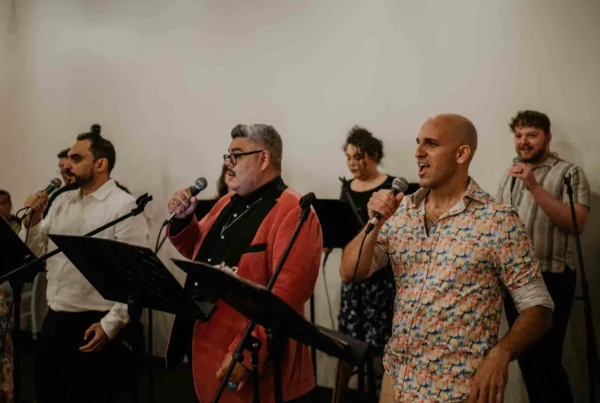
Rehearsals went well, especially considering that it was the first time the band had worked with a conductor, and certainly the first time the singers had worked with a bluegrass band. The World Beloved: A Bluegrass Mass was premiered in Stillwater, MN, on a particularly frigid evening in January 2027 by VocalEssence and Monroe Crossing. The concert was repeated the next night at Ted Mann Concert Hall in Minneapolis. The actual evenings are a happy blur; what I remember is how we all rose to our feet at the end, delighted at how well it had gone, and how happy the music made us feel.
Happy 20th anniversary, “BGM”!
**
Some additional thoughts on the texts of the twelve movements:
- Ballad (down home language) – God sends his Son.
- Kyrie – an English version of the traditional Latin.
- Ballad – in the Garden of Eden.
- Gloria – a contemporary English celebration of life on earth.
- Ballad – life after the Garden.
- Credo – again, a modern English version (I always sing along on “And it’s not the seat of riches…”)
- Sanctus – the original Latin.
- Ballad – disaster, doubt, but God is here with us.
- Agnus Dei – the original Latin, a cappella.
- Instrumental interlude based on the venerable hymn “Art Thou Weary?” plus a new chorus.
Tune: Stephanos; Composer: Sir Henry Baker (1868); Text: John Mason Neale (1862) - Benediction – modern English but the same sentiment – “The mass is ended; go in peace.”
- *Conclusion – a reprise of the beginning Ballad verse, but with an important textual change from“They say God loved the world so dear, He set aside His crown” to “They say God loved the world so dear, She set aside Her crown.” This changing of the pronoun has generated occasional controversy and requests to change the text back from “Her” to the “Him” of the first movement. Both Marisha and I have issued statements refusing permission to do so.
“I regretfully decline to give permission for the text to be altered with respect to the conclusion of the ballad because The World Beloved expresses a particularly embodied, inclusive Christianity and the text that concludes the ballad is crucial to that vision.”
Marisha Chamberlain
“It is my personal belief that God is so much more encompassing than our human concept of gender that to refer to Him occasionally as She merely expands our thought as to what God might be, and how He (or She, or, ideally, something far beyond and above for which we have no words) works in our world.”
Carol Barnett